
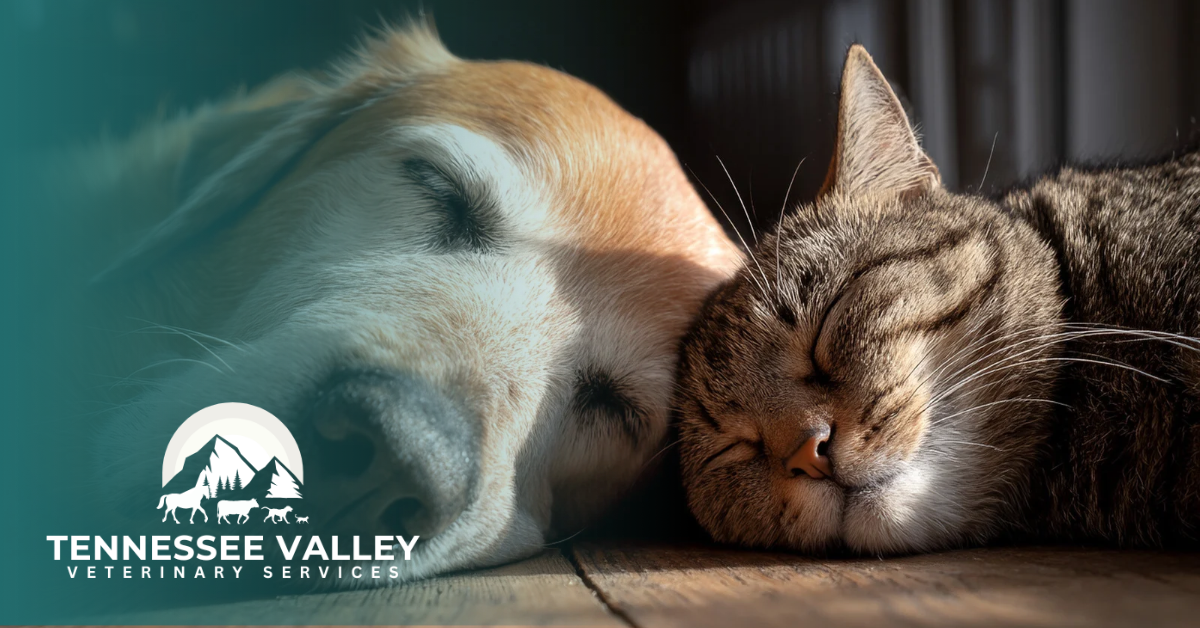
The last thing most pets will ever do is ride in a car. They will sit in an unfamiliar room under bright lights, on a cold metal table, in a place that smells like antiseptic and fear, surrounded by strangers. It is not their fault. It is not yours either. It is simply what the default looks like. At-home euthanasia exists because the default does not have to be the only option.
This post is for families in Morristown and East Tennessee who are approaching one of the hardest decisions a pet owner makes. It covers why the setting matters so much at the end of a pet's life, what the process actually looks like in your home, and two real stories from families we have had the privilege of serving. If you are in crisis right now and do not have time to read, call us directly: (423) 438-3864.
Why the setting matters
Veterinary clinics are built for healing. They are stocked, staffed, and designed around the assumption that the animal who comes in is going to leave. Everything about them -- the smells, the sounds, the surfaces -- signals to an animal that something is happening. For a healthy dog getting a vaccine, that tension is manageable. For an old, sick, or anxious animal in the last hours of their life, it is anything but.
Animals read their environment through senses that operate at a level humans cannot access. Dogs detect fear and stress through scent. Cats are acutely sensitive to unfamiliar spaces. An animal that has spent 10 or 15 years learning that your home is safe and that your couch means rest does not stop knowing that at the end. That knowledge is still in them.
At-home euthanasia does not change what is happening. It changes where it happens. And for most animals, that matters enormously. They can be on their favorite bed. They can have their person's hand on them. They can fall asleep in a room they have slept in a thousand times before. That is not a small thing.
There is also the reality for families. A clinic waiting room, even a compassionate one, is a public space. At home, you can cry. You can play their favorite song. You can say whatever you need to say without feeling watched. You can take as much time as you need. If you have children or other pets who need to be part of this, they can be. If you need to step out and come back, you can do that too.
"The last thing most pets will ever do is ride in a car. At-home euthanasia exists because it does not have to be."
What actually happens during an in-home visit
We want you to know what to expect before we arrive so that nothing about the process catches you off guard. There is enough weight on a day like this without surprises.
When we arrive, we will take a few minutes to settle in. We will say hello to your pet and let them get comfortable with us before anything medical happens. For most animals, this is not difficult -- they are in their home, on their terms, and we come to them quietly. We are not in a hurry.
The first medication is a sedative. It is given gently, and its job is to let your pet drift into a deep, comfortable sleep. It takes a few minutes. Once your pet is fully relaxed -- resting, breathing slowly, no longer aware -- the final medication is administered. It works quickly, peacefully, and without pain or distress. Your pet's heart stops while they are sleeping. They do not feel it.
You can be holding them through all of this. You can be sitting beside them. You can be in the room or just outside it. We follow your lead entirely. We will confirm gently when it is over, and then we will give you as much time as you need before we do anything else.
From arrival to the time we leave, the visit typically takes between 45 minutes and an hour and a half depending on your pet, your family, and how much time you want. We build the schedule to give you that space. We do not have another appointment waiting behind yours.
Why at-home matters especially for large dogs
There is a practical reality that does not get discussed enough: large dogs at the end of life often cannot be moved safely. A 90-pound Labrador with advanced arthritis, a giant breed with a mass affecting its hind legs, a dog who has not been able to climb stairs for months -- loading these animals into a vehicle is not just difficult, it is painful. In some cases it is not physically possible without causing significant distress.
For families in this situation, the choice is not between home and clinic. The choice is between at-home euthanasia and a crisis. We have seen families attempt to transport a large dog to a clinic and arrive already shaken, the dog already frightened and hurting from a ride they were not able to weather well, and then face the final moment in a state of anxiety that no one wanted.
At-home euthanasia for large dogs means the dog goes from their bed to sleep. That is it. There is no loading, no ramp, no car ride, no waiting room. They do not have to be brave about anything.
Bear's story: an 11-year-old Malamute and a rainy afternoon
Bear was an Alaskan Malamute. Eleven years old, somewhere around 110 pounds even after the weight he had lost in the months before. His family had known for a while that the time was coming, but they had been dreading the logistics as much as the loss. Bear's hips had gone. He could still get himself around the yard with effort, but the idea of lifting him into a vehicle, of asking him to endure a 20-minute drive, of watching him try to navigate a parking lot and a waiting room floor -- it was not something they could bring themselves to do to him.
They called us and asked if we could come to the house.
Dr. Jacob Harris drove out on a Tuesday afternoon in October. It was raining -- a steady East Tennessee fall rain, the kind that comes off the mountains and settles in for the afternoon. Bear was in the backyard, in his usual spot near the back fence. He had been out there most of the morning. His family had brought a blanket out and were sitting with him.
Dr. Harris went out and sat down in the grass with them. In the rain. He let Bear smell his hand and check him out. They talked for a while about Bear -- what he was like as a puppy, the trip to the Smokies he used to love, the way he would drag his water bowl across the yard when it was empty. Bear put his head down eventually and closed his eyes in the way dogs do when they have decided someone is all right.
The sedative went in gently. Bear went to sleep in his own yard, in the rain, with his family's hands on him and the smell of his own grass around him. Dr. Harris stayed with them until they were ready for him to leave.
"He didn't have to be scared of anything," his owner said afterward. "That's what I keep coming back to. He was in his yard. He just went to sleep."
That is what in-home euthanasia is. That is what it makes possible for a dog like Bear, and for families like his.
Cats and the unique comfort of home
Cats present a specific challenge when it comes to end-of-life care, and it is worth addressing directly. Most cats find the experience of leaving home acutely stressful. The carrier, the car, the smells of a clinic that include other animals, the handling by strangers -- these things are not minor inconveniences for a cat. For a healthy cat, the stress is manageable and temporary. For an old, sick, or failing cat, it is an entirely different experience.
Cats at the end of life often want one thing above everything else: to be still, in their place, with their person. They tend to choose a spot -- a particular chair, a sunny window, the foot of a bed -- and stay close to it in their final days. The act of pulling them out of that spot, putting them in a box, and driving them somewhere loud and unfamiliar is, for many cats, the most frightening thing we could do to them at the time when they are most vulnerable.
At home, a cat can pass exactly where they chose to spend their last days. Their person can be beside them. They can hear the sounds of home, smell what home smells like, feel what they know. They do not have to be held down on a table. They do not have to be brave.
For older cats especially, this is not a small consideration. It is often the most loving one.
Liam Neeson's story: a 15-year-old cat and a Bible verse on a paper towel
A family in our area recently shared a review that we have thought about every day since. Their cat's name was Liam Neeson. He was 15 years old and had been with them through what the review described, in the understatement that only comes from people who have lived something like this, as a lot of life.
When the time came, they found us through a Facebook post. They called, and we made the appointment for the next day so they could have one last day to love on him. Dr. Matthew Harlan came to their home.
They had a way they needed to say goodbye -- a Psalm and a song. Dr. Harlan gave them the time and the space to do that. He let the family lead. He loved on Liam too, the way you do with a cat you have just met but can already see has been deeply loved.
In their bedroom, with Liam in his own space, the family prayed over him as he went. Dr. Harlan heard them. Before he left, he found a paper towel in their kitchen and wrote Genesis 1:26 on it. He left it on the counter and walked out quietly.
The family did not find it until after he had gone.
"The Bible verse he left was a great comfort to us," they wrote, "and an assurance that we had made the right choice, as hard as it was."
We are sharing this story because we believe it says something true about what in-home euthanasia makes possible. Not just the logistics. Not just the absence of a waiting room. But the space for a family to say goodbye in their own way, in their own home, with a veterinarian who understood that his job in that moment was not only clinical.
Dr. Harlan did not plan to leave that note. He heard something real, and he responded to it. That kind of care is not something that happens easily in a clinic, under the pressure of a full schedule, in a room where the next appointment is already waiting. It happens when you have the time and the setting that in-home visits make possible.
How do you know when it is time?
This is the question families ask most, and the honest answer is that there is no single clear signal. What we look for instead is a pattern of quality of life over time.
A useful framework is tracking what we call good days and bad days. A pet who has mostly good days, with occasional hard ones, is typically not there yet. A pet who has more bad days than good -- who is struggling to rest comfortably, who has lost interest in food or in the people and things they used to love, who is in persistent pain that we cannot manage well -- is one whose suffering we should take seriously.
Specific things to watch for in dogs and cats include:
- Inability to get up, move around, or find a comfortable position
- Not eating or drinking for multiple days
- Incontinence that is distressing to them
- Difficulty breathing, persistent coughing, or labored respiration
- Withdrawal from family and from activities they used to enjoy
- A look in their eyes that owners often describe as "they're telling me something"
We want to be available for this conversation before you are in crisis. If you are asking the question, it is worth a call. We would rather talk to you too early than have you carry this alone until it is an emergency.
For more on recognizing end-of-life signs in dogs and cats, our dog care page and cat care page cover ongoing health monitoring across a pet's life. The team page will give you a sense of who you will be working with before you call.
What to expect from us
Tennessee Valley Veterinary Services is a mixed-practice clinic in Morristown, Tennessee. We provide care for dogs, cats, horses, cattle, and livestock across East Tennessee. In-home euthanasia for companion animals is part of the care we offer because we believe it is often the most compassionate option available, and because we have seen what it does for families and for pets when it is done well.
When you call us, you will not be rushed. We will ask about your pet -- their history, their condition, what you are seeing -- and we will help you think through the timing. If you are ready to schedule, we will find a time that works. If you are not sure yet, we will answer your questions and let you call back. There is no pressure.
The veterinarians who do in-home visits at TVVS are Dr. Matthew Harlan, DVM and Dr. Jacob Harris, DVM. They founded this practice with the belief that veterinary care done right means being present for the whole life of an animal -- including the end of it.
We serve Morristown and the surrounding East Tennessee area. Call us at (423) 438-3864 or visit our contact page to reach us.
After your pet passes
We will never rush what comes after. When your pet has passed, we will give you time -- to hold them, to sit with them, to be in the room without feeling like anything needs to happen yet. When you are ready, we will talk through what comes next.
Most families in our area choose private cremation. We can help guide you to local providers in the Morristown and Knoxville area. Some families prefer burial on their own property, which is legal in Tennessee for pets on private land. We will tell you what you need to know and leave the choice entirely to you.
Grief after losing a pet is real. If it catches you harder than you expected, that is not something to be embarrassed about. Organizations like the American Veterinary Medical Association and the ASPCA have pet loss support resources available at no cost. The grief is proportionate to the love, and 15 years of love is worth grieving.
"We would rather talk to you too early than have you carry this alone until it is an emergency. If you are asking the question, it is worth a call."
Frequently asked questions
Does Tennessee Valley Veterinary Services offer at-home euthanasia?
Yes. We provide in-home euthanasia for dogs and cats in Morristown and the surrounding East Tennessee area. We come to your home so your pet can spend their final moments in the place they know. Call us at (423) 438-3864 to discuss scheduling.
Is at-home euthanasia available for large dogs who cannot travel?
Absolutely. Large and giant breed dogs who are too heavy, too arthritic, or too ill to be loaded into a vehicle are one of the most common reasons families choose in-home euthanasia. Our veterinarians come to you -- wherever your dog is most comfortable, whether that is on their bed, in the yard, or on the back porch.
What happens during at-home pet euthanasia?
The process is gentle and typically takes between 45 minutes and an hour and a half from arrival. First, a sedative is given so your pet drifts into a peaceful sleep. Once they are fully relaxed and no longer aware, the final medication is administered. Your pet does not feel pain, they do not struggle, and they do not have to be afraid. You can hold them, sit beside them, or step away -- it is entirely your choice.
How do I know when it is time?
We look for whether your pet is having more bad days than good, whether they are still eating and drinking, whether they can rest comfortably, and whether the things that used to bring them joy still do. We encourage families to call us early for this conversation. You do not have to wait for a crisis.
Can other pets and family members be present?
Yes, and many families choose to include them. Other pets in the household often benefit from being present so they understand their companion is gone. Children who are old enough to understand can be included or not -- that is your call. There is no right answer, only what feels right for your family.
What do we do after?
We will discuss options with you ahead of time. Many families arrange private cremation through a local provider. We can help guide you on what is available in the Morristown and Knoxville area. We will give you space and time -- there is no rushing on our part.
Is at-home euthanasia more expensive than a clinic visit?
There is typically a house-call fee in addition to the service. For most families, the peace and privacy of being at home, not having to transport a sick or anxious pet, and being surrounded by familiar smells and sounds makes that difference worth it. Call us to discuss pricing for your situation.
Do you serve areas outside Morristown for in-home euthanasia?
We serve Morristown and much of the surrounding East Tennessee region. Call us at (423) 438-3864 to confirm we can reach your area.
Reach out to us
If you are reading this because you are approaching this decision with your own pet, we are sorry. It is one of the hardest things, and there is no version of it that does not hurt. What we can offer is a way to make the final chapter as peaceful as possible -- for your pet, and for you.
Tennessee Valley Veterinary Services is located at 5023 Old White Pine Road, Morristown, TN. We are open Monday through Friday, 8:00am to 5:00pm. For in-home euthanasia scheduling and end-of-life consultations, call us at (423) 438-3864 or use our contact form. We will get back to you the same day.
You can also learn more about the dogs and cats we care for across East Tennessee on our dog services page and cat services page, and read more about our veterinarians on the meet the team page.